Sunday, June 8, 2008

Sequoyah and His Talking Symbols

Vonore, Tennessee. The wind whipped around me like bitterness.

"These grounds are not yours," the whispering past said.

"I come with respect," I said replied silently and for a few moments, there was no wind, no coldness. This was familiar territory and my footsteps, leaving nothing behind on the pavement of the parking lot, were perhaps remembered. So many dark and cold nights, I had walked here, learning basic Cherokee. It does not get much more romantic than this - learning a language where its academic record began. This is the site where Sequoyah, who created the Cherokee Syllabary, a method for recording and communicating the language in a written form was born.


  • MUSEUM LOCATION:
    • Latitude: 35.585192,
    • Longitude: -84.220438
    • 576 Highway 360 - Vonore, TN 37885
  • A LITTLE HISTORY:
    • The museum is located very near the site of Tuskeegee, the village where Sequoyah was born.
    • Sequoyah was born in 1776.
    • He created the Cherokee Syllabary in 1821.
    • The syllabary is composed of 85 symbols.
    • It took him 12 years to create it.
  • STRUCTURES:
    • Museum and grounds.
  • CURRENT USAGE:
    • Museum

The Monkey Trial


Dayton, Tennessee. I have always enjoyed a good spin, and when I find something incredibly famous that turns out to be about spin, well, so much the better. The Scopes Trial. Spin, spin, spin and more spin.

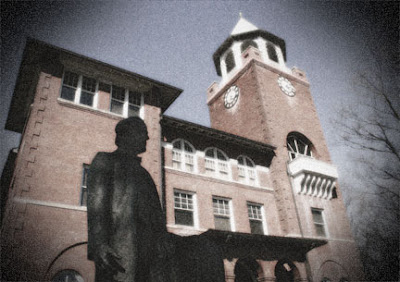
There were a couple of historic places that caught hold of me when I moved to Tennessee. I fell in total love with the Secret City, but I also harbored a quiet crush on the Scopes Trial. It amazed me that I had moved so close to a place where evolution and the bible collided. However, I was misguided. Here I thought the whole Scopes Trial was all about two impassioned sides - one holding fast to religious doctrine, the other side, science barging in with good old evolution. Quite a fight to sink one's teeth into.

But no. It was not so simple, or rather it was even more diluted than my beliefs. Rather, the trial was a publicity stunt. Can you imagine? Who knew? The Scopes Trial was the brainchild of George Rappalyea, the manager of a local coal company in Dayton, TN. To encourage the economy of the town, he instigated the whole deal. The American Civil Liberties Union had publicized they would help defend anyone who rose up against the Butler Act of Tennessee (a law that mandated that teachers would give the biblical interpretation of the the rise of man as opposed to Darwinian evolution). Rarralyea saw an opportunity and realized that if he could find a teacher willing to include evolution and the ascent from primates to man in the science curriculum, well, the trial that would happen would be huge. It would bring attention to the declining town. (1)

And so John Scopes, a football coach, took his seat in history and while substitute teaching for a science teacher at Rhea County High School, had his students read about evolution in Civic Biology. Cue the circus.

The court case was huge, incredibly famous and yes, it did all that Rappalyea had hoped. Spin, spin, spin.


  • MUSEUM LOCATION:
    • Latitude: 35.493167
    • Longitude: -85.012444
    • 1475 Market Street - Dayton, TN 37321
  • A LITTLE HISTORY:
    • The Scopes Trail happened in July 1925.
    • William Jennings Bryan prosecuted the case.
    • Clarence Darrow defended the case.
    • Scopes was found guilty.
    • The court room was restored in 1979.
  • STRUCTURES:
    • Rhea County Courthouse
    • Basement is a museum.
    • The original court room is on the second floor.
  • CURRENT USAGE:
    • Court House
    • Museum

Friday, May 16, 2008

A Favor


Just a quick favor, if you please...

Stop by laketrees.blogspot.com and vote for my art work. I am #11 (you might want to double check that). This is an art contest and I have entered my Waverly Hills photo (see above).

Laketrees is the web site of Kim Barker, a wonderful artist in her own right. She is based in Australia.

Tuesday, May 13, 2008

Mariongrad


Marion, KY. It isn't really historic, but the game is as old as imagination. As long as there has been a desire to play toy soldiers, war gaming has been popular past time. And then there is something about stepping back in time or at least attempting such as a feat and putting on the shoes (or muddy boots) of our forefathers. This is the thrill of reenacting for me.

In this regard, this past weekend found me in Marion, KY with my comrades, wearing the WWII uniform of the Red Army (it never hurts to walk a few miles in other's shoes) and taking out my newest addition to the camera collection into the field (woods). It is a 1937 Fed 1. Basically it looks like Leica (but it so isn't). Needless to say there were a few unforeseen glitches - film jams and take-up spool issues (yes, yes, yes, I shot a role to try it out before hand). I admit this is the first time my camera equipment included pliers.

Ultimately, I lost several photographs (I am trying not to mourn them, but it is hard). But the few I did get are on flickr. Ultimately, I still have to get to know this camera. The results tease me enough to continue the relationship.

Also, for those of you wanting to experience Mariongrad, it is an event that is not a public demonstration. However, if you would like to join The 19th Brigade of the 8th Guards Mechanized Corps (the Red Army -reenacting group), just leave a comment, and I'll try to get you to the right people.


www.flickr.com


Sunday, April 13, 2008

Coal Creek


Lake City, Tennessee. It was a Saturday and typical of this photo project, I drove right past my destination, the Lake City Coal Mine Museum. Finally, after stopping to ask directions (the local police were very helpful), I turned around and found myself at the town's community center. I went in one door and landed at a dead end. Hmmm. No museum. The screaming in my head began to get really loud. Oh, no. Not again, I thought. Why is this so hard? I am a museum person. I have a radar for finding them. Why is it so hard to locate them in Tennessee?

So, I took a breath and walked around to the front of the building. Oh, thank goodness. There it was, right where it was suppose to be. There was the sign, yet in front of the door, there was also a grill. Strange. But there seemed to be a few people inside, so in my companion and I went.

Basically, it is a one room museum. However, if you are thinking about visiting it, you may want to call in advance. It has the feel of a private collection that is in the process of needing to be cataloged and labeled. There is a proposal in the works, apparently, to create a much larger national coal mining museum.

After fifteen minutes or so, we wandered out and decided to go on the Motor Discovery Tour of the Coal Creek mine disasters. It is a fascinating history. That was challenging as well, as the tour really does not exist. It, like the museum, is holding its breath for signage and funding (sorely needed). So, we meandered and made a day of it, looking for the past, sometimes finding it, sometimes not.


  • MUSEUM LOCATION:
    • Latitude: 36.222898
    • Longitude: -84.157441
    • 216 N. Main Street - Lake City, TN 37769
  • A LITTLE HISTORY:
    • Coal Creek was the site for the Cold Creek Coal War of 1891 to 1892, where miners fought against the notion of coal companies using convict labor.
    • Location of the United States' third largest mining disaster - the 1902 Fraterviller Explosion.
    • Location of the 1911 Cross Mountain mine disaster.
  • STRUCTURES:
    • Lake City Coal Miner's Museum
    • Bridges, churches and other structures along the Motor Discovery Tour.

Sunday, April 6, 2008

Waverly Hills Sanatorium


Waverly Hills, Kentucky. Thousands of people have walked these corridors. Thousands of people died in these rooms. Hundreds of people walk in the darkened footsteps of the past, during the haunted hours, looking for the dead. I, too, awed by the history, the architecture and the decay, spent a cold, early spring night on the property. I listened. I looked. I communed with the past, and as certain subjects beckon me, entice me, obsess me, Waverly Hills Sanatorium caught my heart and pulled. Joining my fellow Forteans on this excursion, I soon tired of random clicks of the shutter into dark nothingness. The glare of electric strobes froze my interest even more. So after strolling on the fifth floor, I indulged my creative muse and photographed her as best I could, paying homage to my romance of what once was here.


  • LOCATION:
    • Latitude: 38.130147
    • Longitude: -85.841728
    • 4400 Paralee Lane, Louisville, KY 40272
  • A LITTLE HISTORY:
    • Waverly Hills was named such because of a small, one room school house that had been located on the property before the sanatorium was built. The school teacher there named her school that because of her love of Scott's Waverly novels. 1
    • The first tuberculous sanatorium on the property was a two-story structure that could hold between 40 and 50 patients. 1
    • The structure that still stands, was completed in 1926 and could hold around 400 patients. 1
    • Waverly Hill Sanatorium closed its doors as a tuberculous hospital in 1961. 1
    • In 1962, it became WoodHaven Medical Services, a geriatric home. 1
    • In 1980, the state closed WoodHaven. 1
  • STRUCTURES:
    • The main hospital structure
    • The laundry (information center and gift shop)
    • The Body Chute
  • CURRENT USAGE: Private facility. Paranormal tours are available with reservations and for a fee.

Wednesday, March 12, 2008

Archie Campbell


Bulls Gap, Tennessee. "Do you even know who Archie Campbell is?" my partner asked me as I followed his navigation. Now, I admit I might have gotten him mixed up with Sargent York at one time (I know, I know...), but I had distinctly remembered visiting that home site. Hmmm. Archie Campbell. Did he have something to do with country music? Okay, that is a little lame. This is Tennessee after all. Chances are if you were not military history, football history, you might just be all about the music. Not quite. Try country comedy. And after listening to one of the jokes (it just wouldn't be right to tell it all, brother, not on this here page), I too discovered the joys of Rindercella.


  • LOCATION:
    • Latitude: 36.255612
    • Longitude: -83.08636
    • 3139 S. Main Street, Tennessee 37711
  • A LITTLE HISTORY:
    • Archie Campbell was born in Bulls Gap, Tennessee on November 7, 1914.
    • He began his career as a disc jockey at WNOX in Knoxville.
    • He was in the Navy during WWII.
    • Country Playhouse, Knoxville's first country television show featured his personality, plus he also helped start it.
    • When the show ended, he went onto the Grand Ole Opry.
    • In 1968-9, he became a member of the cast of the television show Hee Haw.
    • Campbell was also a painter and a gallery owner (his college degree from Mars Hill College was in art).
    • He passed away in 1987.
  • STRUCTURES:
    • This is the Archie Campbell Complex.
    • Structures include:
      • The Archie Campbell Museum
      • Archie Campbell's Childhood home
      • A train caboose
  • CURRENT USAGE: Museum and Park